---
title: "The Neptune Blueprint: Moving ONE North America from Tool Access to AI Proficiency"
description: Discover how ONE North America's training program transformed AI tool access into practical skills, enhancing productivity and team engagement in the workplace.
image: https://blog.gopomelo.com/hubfs/260521%20ONE%20Blog.png
---
[](http://www.Gopomelo.com)
- Services
- [Partners & Alliances](https://www.gopomelo.com/partners)
- [Events](https://www.gopomelo.com/events)
- [Blog](https://blog.gopomelo.com)
- [Careers](https://www.gopomelo.com/careers)
- [About us](https://www.gopomelo.com/about-us)
[Contact Us](https://www.gopomelo.com/contact-us)

[](http://www.Gopomelo.com)

- - [EN](https://blog.gopomelo.com/)
- [TH](https://blog.gopomelo.com/th)
[](https://www.gopomelo.com/contact-us)
[](https://www.gopomelo.com/)

- [ Home](https://www.gopomelo.com)
- [ About us](https://www.gopomelo.com/about-us)
- [ Services](https://www.gopomelo.com/services/digital-employee-experience)
- [ Careers](https://www.gopomelo.com/careers)
- [ Insight](https://blog.gopomelo.com)
# The Neptune Blueprint: Moving ONE North America from Tool Access to AI Proficiency
[Dewantoro Putranto Wibowo](https://blog.gopomelo.com/author/dewantoro-putranto-wibowo)
May 21, 2026
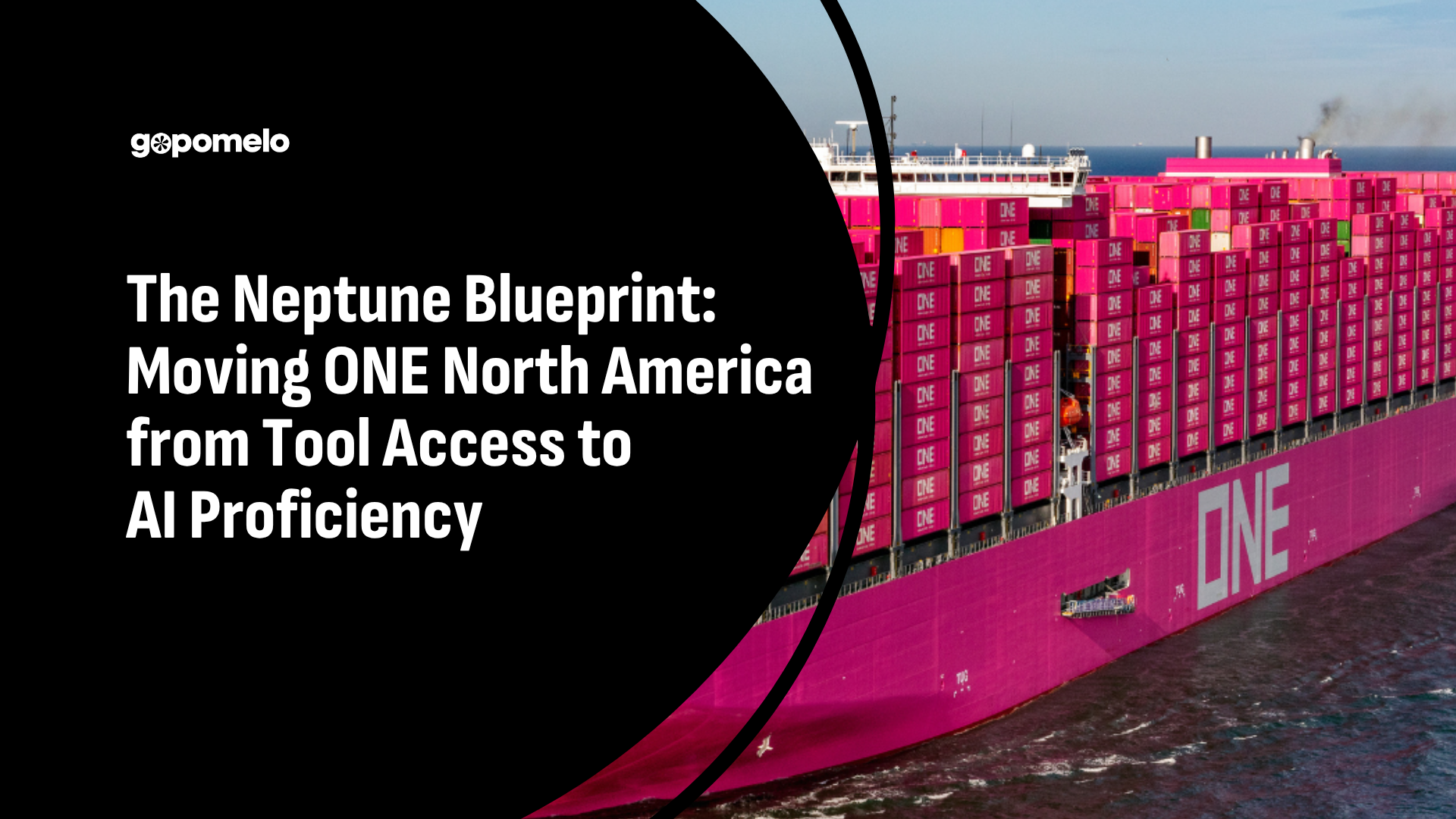
In global shipping, high-end equipment is only as good as the team operating it. The same applies to software. Throughout the first quarter of 2026, **Ocean Network Express (ONE) North America** and **GoPomelo** partnered to ensure that having access to AI tools translated into actual workplace productivity.
This is a review of the **GenAI Advanced Enablement Series**—a program designed to turn curiosity into a practical, everyday skillset.
**The Project Overview (5W1H)**
- **Who:** 200+ ONE North America employees and the GoPomelo Strategy Team.
- **What:** A training series covering Gemini, NotebookLM, and Workspace automation.
- **Where & When:** Virtually across North America, ending in April 2026.
- **Why:** To move beyond basic "chatting" and show how AI can automate real business tasks safely.
- **How:** By using a mock project called "Project Neptune" to let participants practice in a realistic setting.
### **The Strategy: Why We Used a Simulated "Sandbox"**
Standard software training often feels too academic. To avoid this, we created **Project Neptune**—a mock scenario where participants had to manage a transition to a new hydrogen-powered fleet.
Using a mock project instead of live company data was a deliberate choice. It created a "Sandbox" where employees could experiment freely. They could test complex prompts, make mistakes, and troubleshoot without the pressure of affecting real-world operations. This simulation gave the training a clear goal: participants weren't just "learning a tool"; they were solving a business problem.
### **Integrated Tools: How the Ecosystem Works Together**
A major goal of the program was showing that these tools are most effective when used together. We moved away from teaching features in isolation and instead showed how they form a cohesive workflow:%20(50)-1.png?width=826&height=280&name=Events%20Thumbnail%20(1920%20x%201080%20px)%20(50)-1.png)
- **Research & Accuracy (NotebookLM):** Participants learned to "ground" their work in facts. By uploading technical documents to a private workspace, they ensured the AI pulled answers only from approved sources, significantly reducing errors.
*"The purpose for a pro-user when using NotebookLM is to actually advance problem-solving... to have a place where you can put unstructured data such as thoughts, memos, voice transcriptions, and pictures, and combine that with structured data to find new insights."* **— Dewantoro (Dewa) Wibowo, Senior Consultant, GoPomelo**
- **Logic & Problem Solving (Gemini):** When faced with a hypothetical budget deficit in the Neptune project, we used Gemini’s reasoning models to identify the cause and draft a recovery plan.
- **Communication (Google Slides & Imagen):** To finish the workflow, we used AI to generate professional charts, tables, and presentation slides to report those findings to management.
### **The Course Correction: The Human at the Center**
Midway through the series, we noticed an interesting trend: registration for "Advanced" courses was high, but actual attendance was lower than expected. Feedback suggested that the word "Advanced" made people think the course would be too technical or time-consuming. We made a quick change, rebranding the sessions to focus on **"Task Automation."** But more importantly, we had to shift the mindset of how users interact with the tool. Many users fall into the trap of letting the AI do *all* the thinking. During the Deep Reasoning Masterclass, we tackled this head-on:
*"I am advocating for folks now to just sort of iterate and refine, as we do with everything when it comes to problem-solving. That way, the ownership or the output of the LLM will be more meaningful to you. You can say that whenever you come up to an actual result or finding from the sessions, it is because of you as the human determining and getting to that 'aha moment.'"* **— Dewa Wibowo, Senior Consultant, GoPomelo**
### **The Result: Organic Interest and Measurable Impact**
The most telling sign of success was the **107% Attendance Rate** during our NotebookLM sessions. We had more people show up than had originally signed up. Employees were sharing the meeting links with their colleagues because they found the tools genuinely useful for their daily work.
This shift in mindset was reflected directly in the post-session feedback, where the track achieved an impressive **4.8/5.0 CSAT score**. Participants highlighted the immediate, practical applicability of the training:
- *"The step-by-step instructional style was excellent and helped us build the 'muscle memory' needed to use these tools effectively."*
- *"I now understand exactly which specific AI tools to use for different business tasks, moving far beyond simple chat functions."*
- *"Very engaging and extremely useful for our daily operations. The presentation quality made complex topics accessible."*
### **Key Takeaways for Future Programs**
For any organization looking to improve their team's digital literacy, the ONE North America program provides a clear roadmap:
1. **Use a Mock Project:** Give people a safe place to practice where the stakes are low but the context is high.
2. **Focus on the Workflow:** Show how tools connect to complete a full project, rather than teaching them one by one.
3. **Pace Yourself:** In a world obsessed with AI speed, the most insightful advice often goes against the grain. As Dewa shared with the North America team: *"Don't be afraid when you're using this tool to go slow. Really, really go slow. Take it as you would if you're reading a book."*
As ONE North America moves into the next phase of automation with Google Sheets and Workspace Studio, they do so with a team that isn't just "using AI," but is actively taking ownership of it to work smarter.
**Ready to improve your team’s AI literacy? Contact the GoPomelo Strategy Team to build your custom roadmap.**
---
###### Social Media
#### If you like this blog you can share to your social media.

###### Follow us on
[ Facebook](https://www.facebook.com/gopomelothailand) [ Twitter](https://twitter.com/Gopomelo) [ Linkedin](https://www.linkedin.com/company/gopomelo-co--ltd/) [ Instagram](https://www.instagram.com/gopomelolife/) [ Youtube](https://www.youtube.com/c/Gopomelo)
###### Share To:
[](https://www.facebook.com/sharer/sharer.php?u=https://blog.gopomelo.com/the-neptune-blueprint-moving-one-north-america-from-tool-access-to-ai-proficiency) [](https://twitter.com/intent/tweet?url=https://blog.gopomelo.com/the-neptune-blueprint-moving-one-north-america-from-tool-access-to-ai-proficiency&text=) [](https://www.linkedin.com/shareArticle?mini=true&url=https://blog.gopomelo.com/the-neptune-blueprint-moving-one-north-america-from-tool-access-to-ai-proficiency) [](https://gopomelo.com)
## More from Dewantoro Putranto Wibowo
[](https://blog.gopomelo.com/the-4-step-playbook-for-faster-product-delivery-how-to-stop-app-switching-and-start-shipping)
3 min read
##### [The 4-Step Playbook for Faster Product Delivery: How to Stop App-Switching and Start Shipping](https://blog.gopomelo.com/the-4-step-playbook-for-faster-product-delivery-how-to-stop-app-switching-and-start-shipping)
[**Read More**](https://blog.gopomelo.com/the-4-step-playbook-for-faster-product-delivery-how-to-stop-app-switching-and-start-shipping)
[](https://blog.gopomelo.com/the-neptune-blueprint-moving-one-north-america-from-tool-access-to-ai-proficiency)
3 min read
##### [The Neptune Blueprint: Moving ONE North America from Tool Access to AI Proficiency](https://blog.gopomelo.com/the-neptune-blueprint-moving-one-north-america-from-tool-access-to-ai-proficiency)
[**Read More**](https://blog.gopomelo.com/the-neptune-blueprint-moving-one-north-america-from-tool-access-to-ai-proficiency)
[](https://blog.gopomelo.com/the-navigators-journey-how-gars-sustainability-team-is-redefining-efficiency-with-asana-ai)
[Productivity](https://blog.gopomelo.com/tag/productivity)
2 min read
##### [The Navigator’s Journey: How GAR’s Sustainability Team is Redefining Efficiency with Asana AI](https://blog.gopomelo.com/the-navigators-journey-how-gars-sustainability-team-is-redefining-efficiency-with-asana-ai)
[**Read More**](https://blog.gopomelo.com/the-navigators-journey-how-gars-sustainability-team-is-redefining-efficiency-with-asana-ai)
Back to top 
[](http://www.Gopomelo.com)
Thailand (HQ)
True Digital Park West,
4th Floor, Unit No. 401, Sukhumvit Road,
Bangchak, Phra Khanong, Bangkok 10260
**02 030 0082**
**info@gopomelo.com**
- Company
- [About GoPomelo](https://www.gopomelo.com/about-us)
- [Careers](https://www.gopomelo.com/careers)
- [Contact us](https://www.gopomelo.com/contact-us)
- Resources
- [Blog](https://blog.gopomelo.com)
- [Partners](https://www.gopomelo.com/partners)
- Services
- [Productivity](https://www.gopomelo.com/services/digital-employee-experience)
- [Communications AI](https://www.gopomelo.com/services/communications-ai)
- [Advanced Data & Analytics](https://www.gopomelo.com/services/advanced-data-analytics)
- [Application Modernisation](https://www.gopomelo.com/services/application-modernisation)
- [Managed Services](https://www.gopomelo.com/services/gcp-managed-services)
- [Location Intelligence](https://www.gopomelo.com/services/location-intelligence)
- [Privacy Policy](https://www.gopomelo.com/personal-data-protection-policy)
- Terms and Conditions
[](https://www.facebook.com/gopomelothailand) [](https://www.instagram.com/gopomelolife/) [](https://www.linkedin.com/company/gopomelo-co--ltd/) [](https://www.youtube.com/c/Gopomelo)
Copyright © 2026 GoPomelo Co., Ltd | All Rights Reserved.
